one performer. visuals, lighting, and camera — all of it, live.
status — undergraduate thesis, finished spring 2023. it was built and it runs. classmates sat down and operated it during testing, and it was shown at MTEC Spring Show 2023, the end-of-year show of the program next to mine in the same department. it has not been used at an actual gig — what follows is a design and how it behaves, not a report from a venue.
why it exists
I walked past someone singing on a street corner. they were good — genuinely good — and people kept walking. they carried on playing anyway.
none of that was a failure on their part. somebody walking down a street is not deciding whether the music is worth hearing; they are deciding whether to stop, and stopping needs a reason to exist before the music can be judged at all. a stage, a light, a change in the air — those are what turn passing something into arriving somewhere. an amp on a pavement has no way to offer that.
I was about to start my thesis. the question I took into it was whether the reason to stop could be built cheaply enough to belong to the performer: whether the production that makes a room feel like an event could be had by one person with no crew, no venue and no budget, out of equipment that has only recently become affordable enough to make it possible.
where it came from
three things arrived at once, and the thesis was the excuse to put them together.
two were course projects from the year before — what can you see of sound, which was about making audio drive a picture, and sound reactive record player, which was about designing a physical part and having the assembled thing behave. the third was what I already knew about how a show is actually run.
separately they are three small exercises. the thesis question was whether they add up to something one person could operate.
what it does
- one analysis drives everything — the visuals and the stage lighting move against the same signal rather than each doing their own thing
- a live camera can be pulled into the picture during a set
- a tablet switches modes and takes the lights by hand
- it carries on by itself when nobody is touching it
the constraint that shaped everything
the person this is for is playing. that is not a limitation discovered partway through — it is the premise, and it rules out every design where somebody else is watching a screen. so the whole system had to be operable by one person who is already performing, from where they stand, without looking away for long.
that single requirement decided most of the design:
- all of it is live. the toggles and the sliders both work mid-set as well as before one — change the pattern, turn the sound-reactive lighting on or off, open up how far the heads travel. nothing on the tablet is setup-only.
- it can be held or handed over. the performer can keep it, or give it to somebody standing at the side; in testing it was set up to work either way. one operator is what it has to survive, not what it insists on.
- a custom
TouchOSCinterface on a tablet, so control is one glance and one tap rather than a keyboard and a mouse. - automatic response to audio, so the system keeps doing something reasonable during the stretches when nobody is touching it at all.
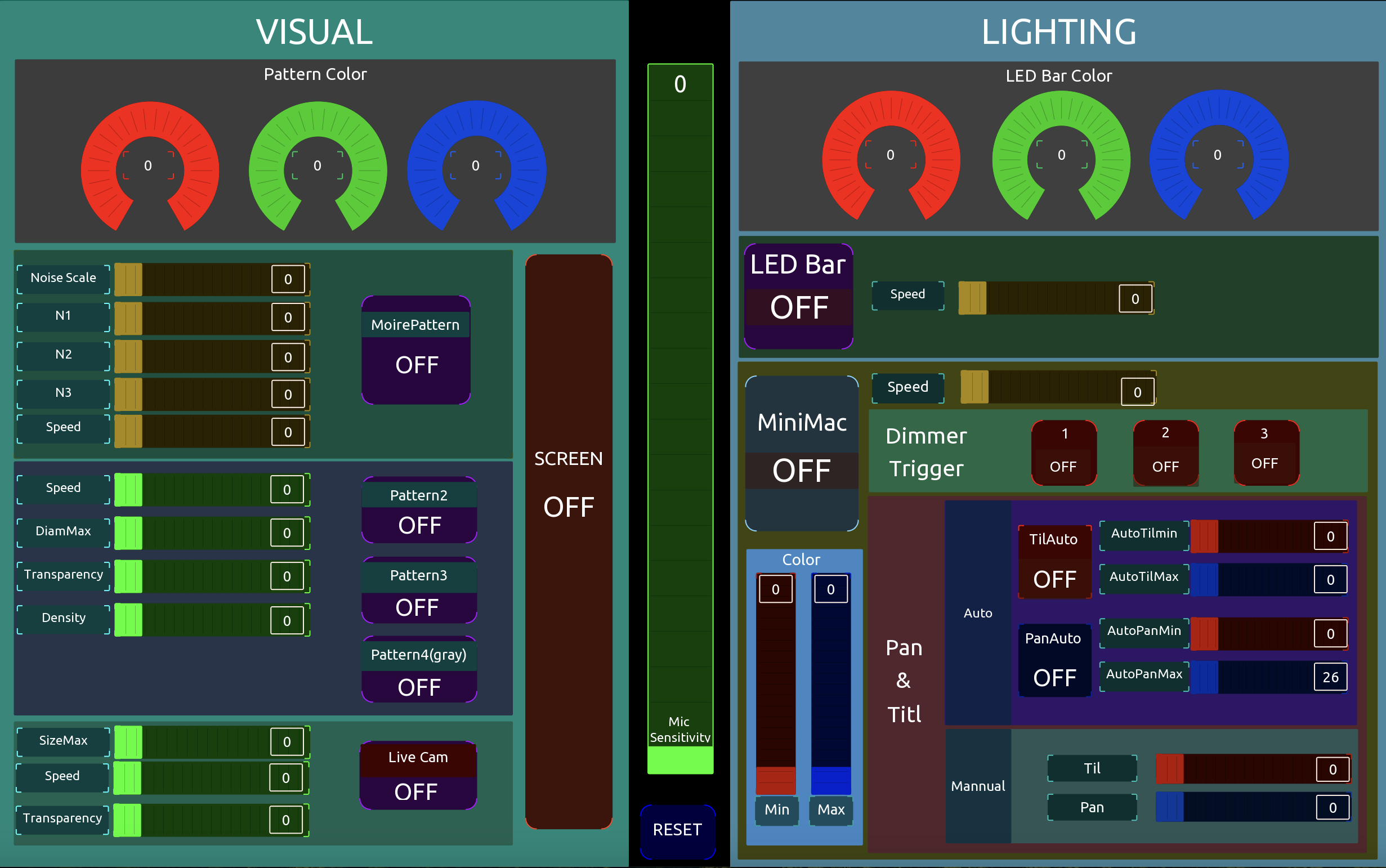
the split down the middle is the whole design in one picture. everything on the left changes what is on the screen, everything on the right changes what is in the room, and the one control they share — how hard the system listens — sits between them.
how it runs
real-time generative visuals, DMX stage lighting and a live camera feed, running together as one instrument rather than as three things that happen to be in the same room.
visuals are generated in Processing, driven by live audio analysis through Minim.
the same analysis feeds DMX output over OSC to moving heads and LED bars, so the
lighting and the visuals move against the same signal rather than merely coexisting.
a live camera feed can be pulled into the visual chain during a set.
handing it to someone who had not seen it before was the only test available for the thing it is actually meant to do, which is hold a stranger's attention.
where it led
this was the first system built around a question that keeps coming back in later work — what does one operator need in order to run this alone, live, without a rehearsal safety net? the escape room show control system is the same question asked about a room instead of a stage.
it also went the other way. echo shadows takes one function out of this — audio moving light — and asks the opposite question about it: what does it have to do if nobody is operating it at all? no tablet, nothing to choose, nobody at the side. the work there went into making it produce more variation on its own than a hand on a tablet was giving it here.
both are worth being able to do, and they are not the same skill. this system is built to be played. that one had to be built to be left alone.